
The Process of Installing Post-Tension Foundations
Post-tension foundations have become the standard for residential and commercial new construction across much of Oklahoma — and for good reason. They outperform conventional rebar-reinforced slabs in the conditions Oklahoma builders deal with every day: expansive clay soils, significant moisture fluctuation, and temperature extremes that put constant stress on anything built on or in the ground. Understanding how post-tension foundations work, how they’re installed, and why they’re specified over traditional alternatives helps builders, developers, and homeowners make informed decisions before construction begins.
At Innovative Concrete Solutions, post-tension foundation installation is one of our core services. We’ve been installing them across Oklahoma City and the surrounding region since 2009. Here’s a thorough look at how the process works and what makes this system perform the way it does.
What Is a Post-Tension Foundation?
A post-tension foundation is a concrete slab reinforced with high-strength steel tendons — cables housed in plastic sheaths — that are tensioned after the concrete has reached adequate compressive strength. That tensioning process is what separates post-tension foundations from conventional rebar-reinforced slabs.
In a standard rebar slab, the steel reinforcement is passive. It sits within the concrete and resists cracking only after cracking has already begun. In a post-tension slab, the tendons are actively stressed — pulled to a specified tension using hydraulic jacks and anchored at the slab edges. That applied tension places the entire concrete slab into compression, which concrete handles extremely well. The result is a slab that actively resists the tensile forces that cause cracking rather than simply reacting to them after the fact.
The Post-Tensioning Institute identifies slab-on-ground post-tensioning as one of the most effective methods for controlling cracking and differential movement in expansive soil conditions — precisely the conditions that define much of Oklahoma City’s building environment.
Post-Tension Foundations vs. Conventional Rebar Foundations
The comparison between post-tension and conventional rebar foundations comes down to how each system handles soil movement and tensile stress — and in Oklahoma, that distinction matters significantly.
A conventional rebar-reinforced slab relies on mass and passive steel reinforcement to hold the slab together as soil shifts beneath it. When expansive clay swells or contracts, it exerts upward and lateral pressure on the slab. The rebar resists cracking up to a point, but once tensile stress exceeds the concrete’s capacity, cracking occurs. Those cracks then become pathways for moisture, which accelerates further deterioration.
A post-tension slab addresses this differently. The active compression placed on the slab by the tensioned cables counteracts the tensile forces generated by soil movement. The slab is essentially pre-stressed to handle the loads and movement it will experience over its lifetime. The practical results include:
Thinner slabs with equivalent or greater strength. Post-tension slabs can be designed thinner than conventional slabs performing the same structural role, which reduces concrete volume and overall project cost without sacrificing performance.
Fewer control joints. Because the post-tensioning controls cracking more effectively, fewer saw-cut control joints are needed. This results in a cleaner slab surface and fewer potential weak points.
Better performance on expansive soils. For Oklahoma City’s clay-heavy soils specifically, post-tensioning provides a measurable advantage in long-term slab stability. The American Concrete Institute recommends post-tensioned slab design for sites with highly plastic clay soils — a category that applies broadly across the OKC metro and much of central Oklahoma.
Longer spans without intermediate support. Post-tension systems allow for longer clear spans, which gives architects and structural engineers more flexibility in floor plan design for both residential and commercial construction.
The tradeoff is installation complexity. Post-tension foundations require experienced crews, precision in tendon layout and tensioning, and proper stressing equipment. Done correctly, the results are significantly better than a conventional slab in Oklahoma soil conditions. Done incorrectly, the consequences are difficult and expensive to correct.
Why Post-Tension Foundations Perform Well in Oklahoma
Oklahoma’s soil is among the most challenging in the country for slab-on-grade construction. The native clay is highly plastic — it expands significantly when it absorbs moisture and contracts when it dries. In the Oklahoma City metro, that shrink-swell cycle is exaggerated by the region’s weather patterns: heavy spring rainfall followed by hot, dry summers that pull moisture out of the soil rapidly.
That seasonal moisture cycling creates differential movement beneath a slab — some areas of soil swelling while adjacent areas remain dry and contracted. That differential is what causes conventional slabs to crack and heave unevenly. A post-tensioned slab, under active compression, is far more resistant to that differential movement. The entire slab acts as a unified structural element rather than a collection of sections held together by passive reinforcement.
For residential new construction in Oklahoma City, post-tension foundations have become the preferred system among quality builders for exactly this reason. They deliver consistent, long-term performance on the soil conditions that exist here — not soil conditions that exist somewhere else.
The Post-Tension Foundation Installation Process
Installing a post-tension foundation requires precise sequencing. Each phase builds on the last, and errors at any stage affect the performance of the finished system.
Site Preparation and Subgrade Work
Before any concrete is placed, the site is excavated, graded, and prepared to the design specifications. In Oklahoma City, this means evaluating the native clay, removing any unstable or organic material, and establishing a compacted subgrade that will support the slab uniformly. A gravel base is typically installed to promote drainage and provide a stable, uniform bearing surface. A vapor barrier is placed over the subgrade to manage moisture migration through the slab.
Tendon Layout and Placement
The post-tension tendons — high-strength steel cables in protective plastic sheaths — are laid out across the prepared subgrade according to the structural engineer’s design drawings. Tendon spacing, profile, and placement height within the slab thickness are all specified to optimize the compression pattern across the slab. Chair supports hold the tendons at the correct elevation within the slab depth. Perimeter edge forms are set to the required dimensions, and any additional mild steel reinforcement specified by the engineer is placed at this stage.
Concrete Placement
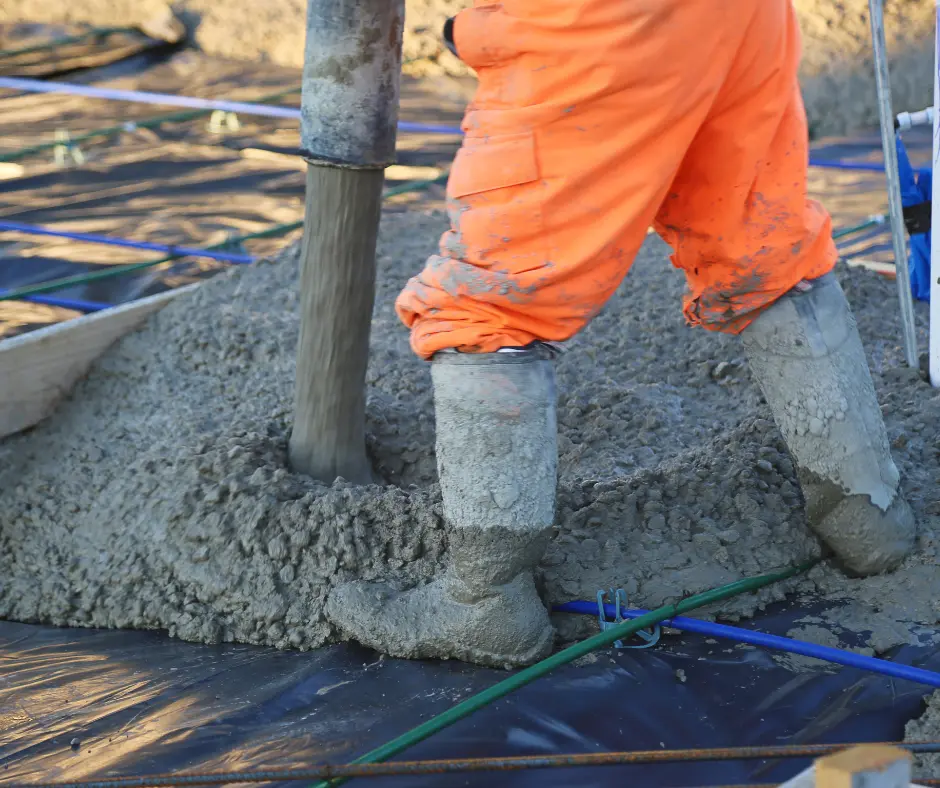
Once the tendon layout is inspected and confirmed, concrete is placed and finished. The mix design is selected for the site conditions and structural requirements — in Oklahoma’s summer heat, that often means scheduling early morning pours, using retarding admixtures to extend working time, and implementing wet curing protocols immediately after finishing to protect the surface during the critical early strength gain period.
Stressing the Tendons
After the concrete reaches the minimum compressive strength specified by the engineer — typically between 2,000 and 3,000 psi, usually within 3 to 7 days depending on conditions — the tendons are stressed using hydraulic jacks. Each tendon is pulled to a specified tension, typically around 33,000 pounds of force, and anchored at the slab edge using a wedge-and-anchor system. The stressing sequence follows the engineer’s specifications to ensure even compression distribution across the slab.
This is the step that requires the most precision and experience. Understressing leaves the slab without the full compression benefit. Overstressing can damage the concrete at the anchor points. Proper stressing equipment, calibrated jacks, and experienced crews are non-negotiable at this stage.
Anchor Protection and Finishing
Once all tendons are stressed and confirmed, the anchor pockets at the slab edges are filled with non-shrink grout to protect the anchor hardware from moisture and corrosion. The slab is then allowed to complete its curing process before construction above grade begins. The Federal Highway Administration’s post-tensioning guidelines identify proper anchor protection as critical to long-term system performance — corrosion at the anchor is one of the primary failure points in post-tension systems that aren’t properly detailed and protected.
What to Expect From a Post-Tension Foundation Long Term
A properly designed and installed post-tension foundation is built for the long term. The active compression in the slab continues to perform over the life of the structure, resisting the soil movement and moisture cycling that Oklahoma’s climate delivers year after year. Unlike conventional slabs that may require crack repair, lifting, or remediation within 10 to 15 years on problematic soils, a well-built post-tension slab on a properly prepared subgrade routinely performs for 30 to 50 years without structural intervention.
The key words are properly designed and installed. Post-tensioning delivers its advantages only when the engineering is sound, the tendon layout is correct, the concrete reaches adequate strength before stressing, and the stressing is performed accurately. These aren’t steps that can be rushed or approximated.
At ICS, we bring the same attention to detail to every post-tension foundation we install — from the subgrade prep through the final anchor protection. To learn more about how post-tension foundations compare to other foundation systems we install, visit our post-tension foundation services page or read our overview of footing and stem wall foundations to understand when each system is the right call.
Ready to talk through your next foundation project? Call Innovative Concrete Solutions at (405) 471-6067 or contact us online. We’ll help you build it right from the ground up.
Author: Steven Smith